How Vector Databases Help AI Remember
How machines store and recall meaning, not just data
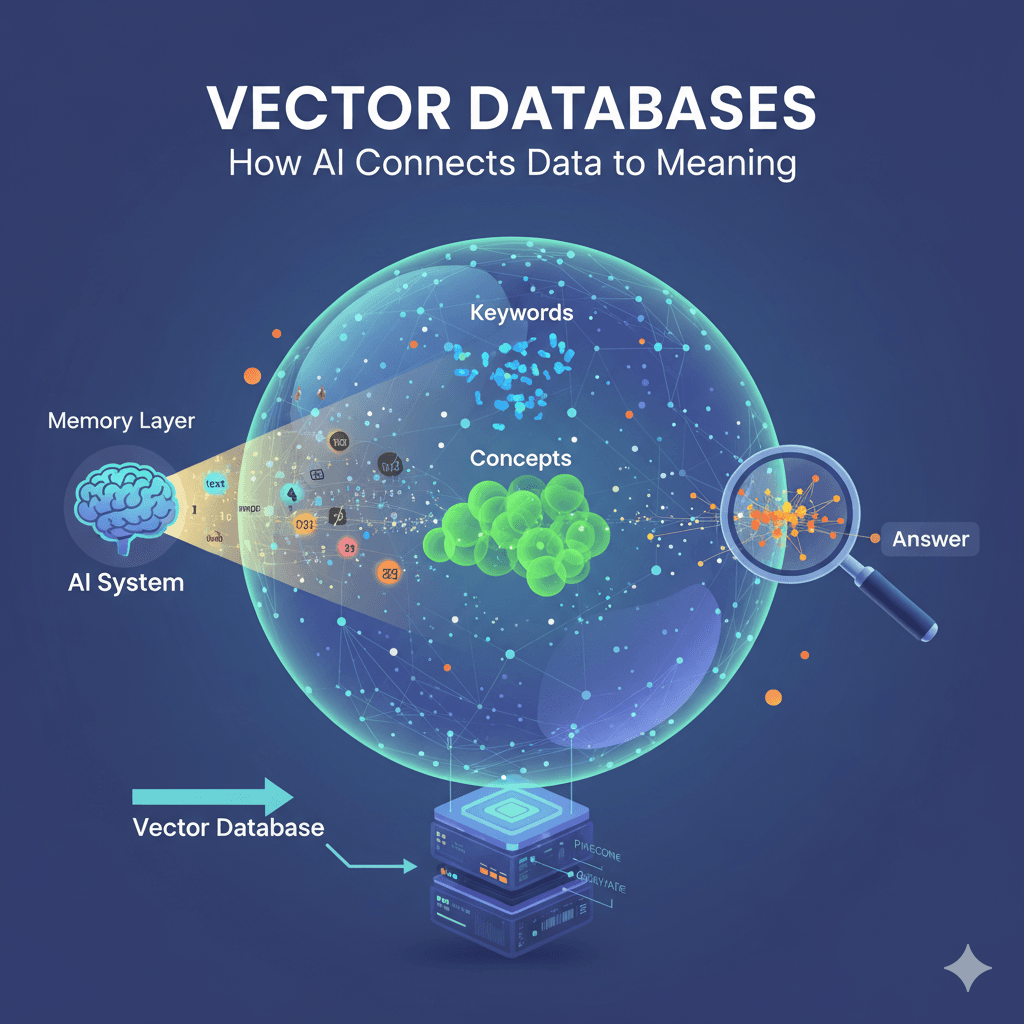
Think about how you search for things online. You type a few words — “best pizza near me” — and expect the system to understand what you mean, not just what you type. But computers didn’t always work like that. For a long time, they only understood exact matches, not meaning.
The shift from searching by keywords to searching by concepts is one of the biggest changes in how machines think. And at the heart of that shift lies something called a vector database — a special kind of storage that lets AI systems remember not just data, but what that data means.
From Keywords to Meaning
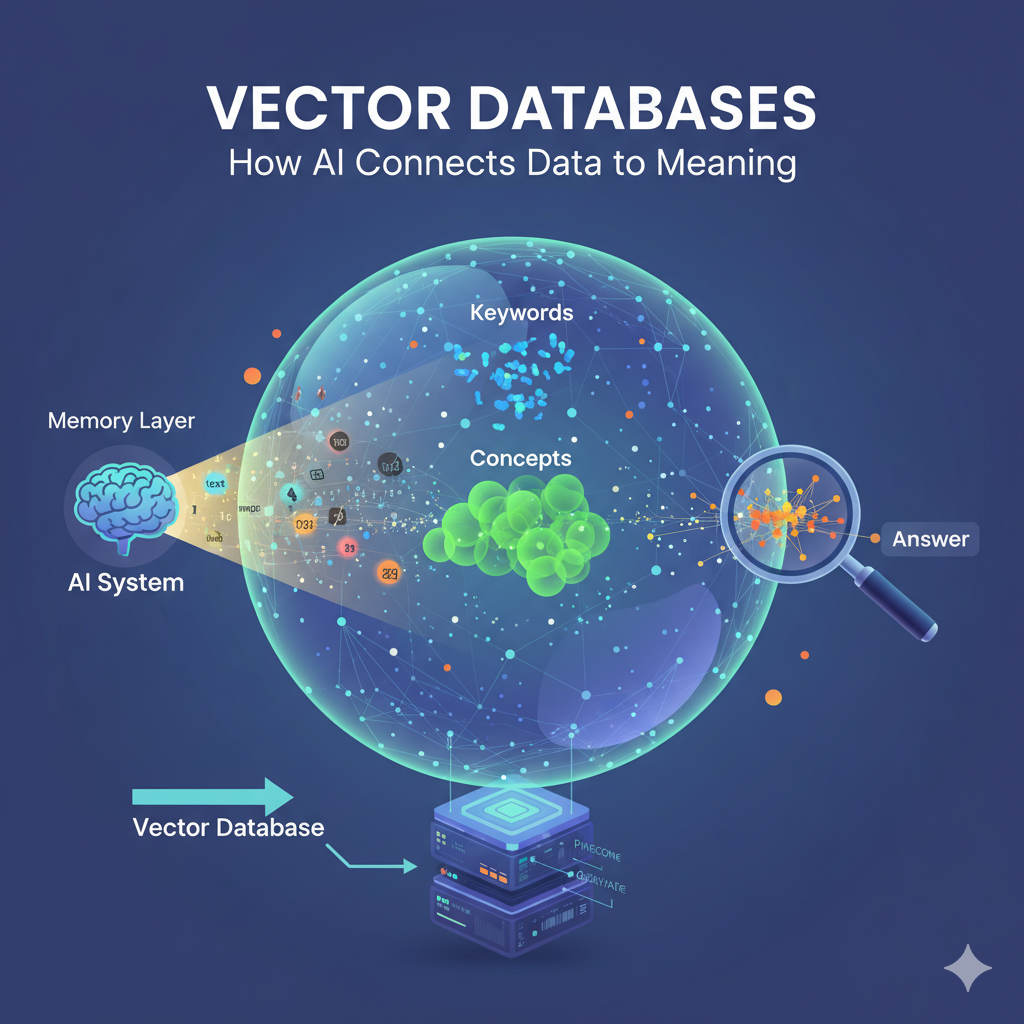
Early search engines were like librarians who could only find exact words on a page. If you searched for “car,” they’d miss results that said “automobile.” Machines simply didn’t understand that those two words meant the same thing.
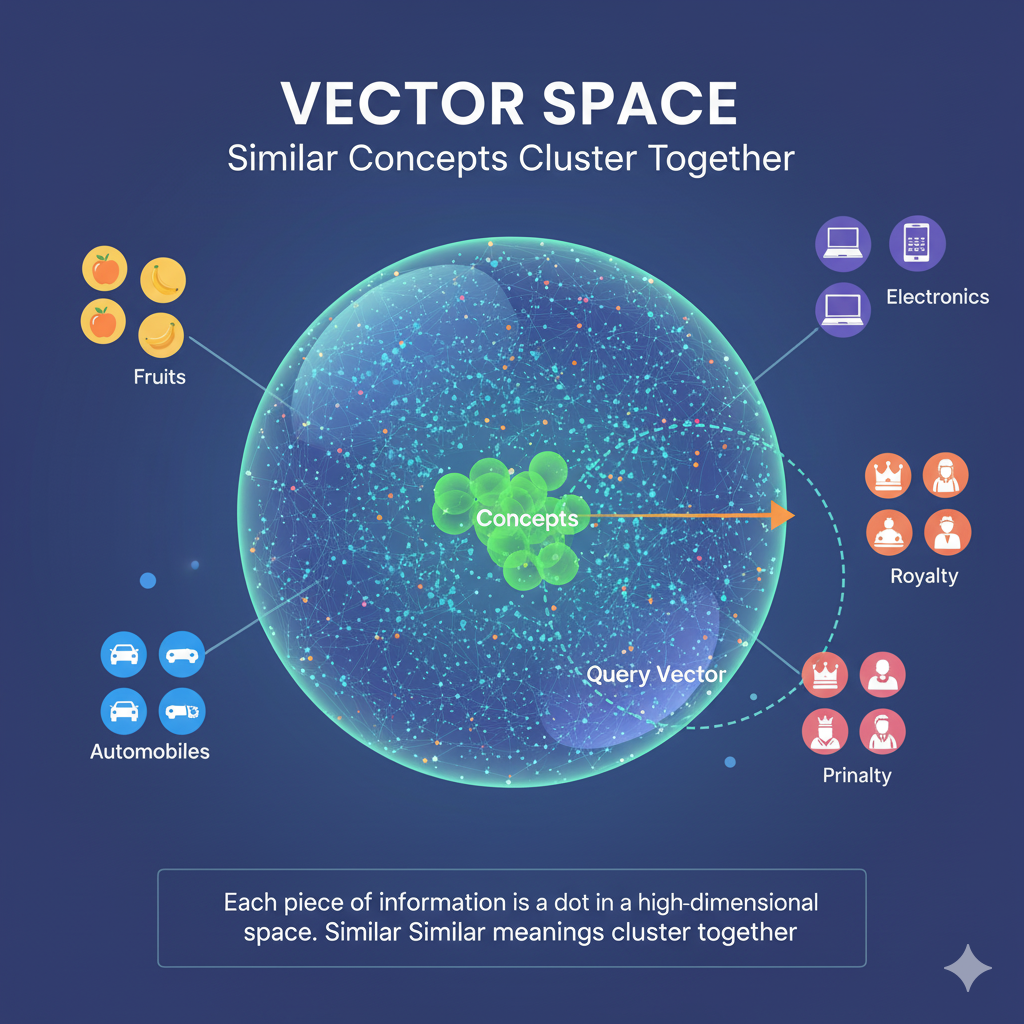
Then came a breakthrough: embeddings. These are mathematical representations of text — numbers that capture meaning instead of just letters. For example, in this new system, “king” and “queen” would appear close together in space, while “apple” and “laptop” would sit far apart. Suddenly, machines could measure similarity the way humans do.
So What’s a Vector Database?
When every piece of information is turned into a vector — a list of numbers — we need a way to store and search through them efficiently. That’s what a vector database does.
Unlike regular databases that match exact text or numbers, vector databases look forthe nearest neighbor — the most similar point in a high-dimensional space. Think of it as searching for “things that feel like this” instead of “things that are exactly this.”
Why Does AI Need It?
Modern AI systems — like chatbots, recommendation engines, and search assistants — rely on retrieving relevant information quickly. When you ask ChatGPT a question about a company policy or product, it doesn’t search for keywords; it finds the closest match in meaning.
That’s powered by vector databases. They make it possible for AI to:
- Find similar meanings even when words differ (“doctor” ≈ “physician”).
- Recall knowledge efficiently from millions of stored vectors.
- Enable personalization — like showing products similar to what you viewed.
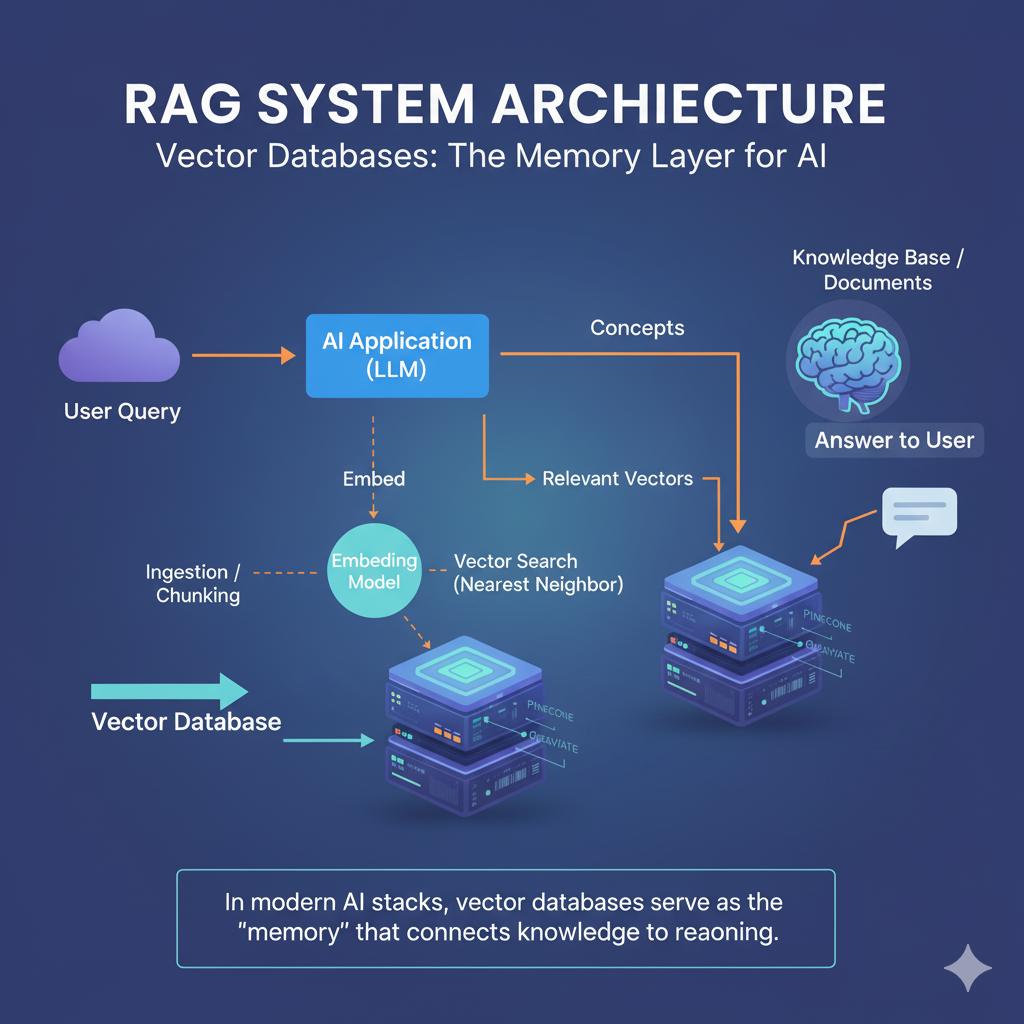
- Support Retrieval-Augmented Generation (RAG) — giving LLMs factual grounding.
Popular Systems
A few names dominate the vector database world right now: Pinecone, Qdrant,Weaviate, Milvus, and FAISS (from Meta). Each focuses on speed, scalability, and integration with AI workflows. In many setups, the vector database acts like the “memory” layer of the entire system — where meaning is stored.
How It All Comes Together
Imagine uploading your company’s documents to an AI assistant. The text is converted into vectors and stored in a vector database. When someone asks, “What’s our refund policy?”, the system finds the most semantically similar document — not by matching words, but by understandingmeaning. Then the AI reads that document and answers accurately.
This combination of retrieval and generation — often called RAG — is what makes AI assistants useful in real business settings today.
Final Thoughts
Vector databases might sound like an internal system detail, but they’re quietly redefining how machines handle knowledge. They’re how AI remembers context, meaning, and relationships — not just data.
In a way, they’ve given computers something they never really had before: a sense of similarity. And from that simple idea, a whole new kind of intelligence is being built.